If you are considering the Upper West Side, you are probably asking a very practical question: what does daily life there actually feel like? This is one of Manhattan’s most established residential neighborhoods, but it is not defined by just one landmark or one type of resident. To understand it well, you need to picture the rhythm of the streets, the housing stock, the parks, and the tradeoffs. Let’s dive in.
Upper West Side feel
The Upper West Side sits in Manhattan Community District 7, stretching from 59th Street to 110th Street between Central Park West and the Hudson River. In the 2020 census data cited by Community Board 7, the district had 222,129 residents, which helps explain why the neighborhood feels active, layered, and fully urban.
This is also one of the densest residential neighborhoods in the country, according to NYC DOT. That density shapes your experience in a very real way. The area feels walkable, busy, and closely connected, not spread out or car-oriented.
At the same time, the Upper West Side is strongly residential. City Planning describes it as a dense residential district organized around three major commercial corridors: Broadway, Amsterdam Avenue, and Columbus Avenue. That balance gives the neighborhood a lived-in feel rather than a purely office or tourist identity.
Streets vary by avenue
One of the most important things to know is that the Upper West Side does not feel the same on every block. Broadway generally reads as the larger, busier corridor, with room for bigger retail and residential development. Amsterdam and Columbus tend to feel more neighborhood-scaled, with smaller storefront patterns and a more intimate street rhythm.
That difference matters when you are apartment hunting. Two homes that are only a few blocks apart can offer very different street experiences. One may feel more energetic and high-traffic, while another may feel quieter and more residential.
This block-by-block variation is part of the neighborhood’s appeal. If you value nuance in streetscape and building character, the Upper West Side offers it in a way that feels distinctly Manhattan.
Parks shape daily life
The Upper West Side is framed by two major parks, and that changes everyday living in a meaningful way. On the east side, you have Central Park, which the Central Park Conservancy notes spans 843 acres. On the west side, Riverside Park runs along the Hudson and stretches more than 400 acres from 59th Street to 181st Street, according to Riverside Park Conservancy.
For many residents, those parks are not occasional destinations. They are part of the weekly routine. A morning walk, a run after work, a weekend bike ride, or a simple break on a bench can all fit naturally into life here.
That park access is one reason the neighborhood feels more balanced than some equally dense parts of Manhattan. You still get the energy of the city, but you also get room to reset.
Culture is built in
The Upper West Side also stands out because culture is woven into everyday life. Lincoln Center sits on the neighborhood’s southern end between West 62nd and 65th Streets and Columbus and Amsterdam Avenues. The American Museum of Natural History sits along Central Park West between West 77th and 81st Streets.
What matters is not only that these institutions are here, but that they become part of the local rhythm. In practice, that can mean dinner on one of the avenues followed by a performance, or a museum visit folded into an ordinary afternoon. Community Board 7 describes the area as drawing residents and visitors with cultural institutions, parks, retail, restaurants, and diverse architecture.
That combination gives the Upper West Side a lifestyle that feels full without needing to feel performative. You are not chasing a version of city life there. You are living inside it.
Housing stock and architecture
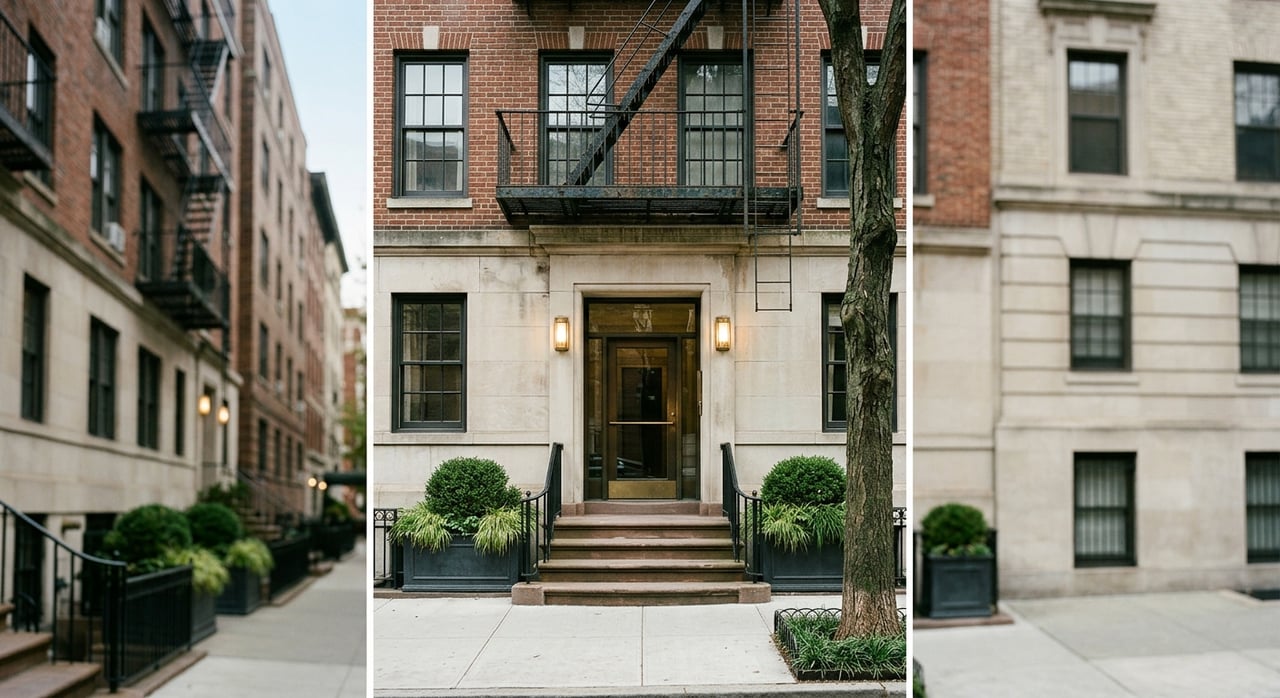
If you care about buildings, the Upper West Side has real depth. The Landmarks Preservation Commission map shows several historic districts in the neighborhood, including Upper West Side/Central Park West, Riverside Drive-West 80th-81st Street, Riverside-West End, West End-Collegiate, and West End-Collegiate Extension.
A large stretch along the park edge is protected within the Upper West Side/Central Park West Historic District. The LPC describes that district as primarily characterized by residential, institutional, and commercial buildings from the late 19th to early 20th centuries.
In plain terms, this is a neighborhood where older apartment houses and prewar fabric play a major role in the streetscape. You will also find newer residential pockets, but the broader feeling is one of architectural continuity rather than constant reinvention.
That can be especially appealing if you are drawn to classic Manhattan apartment living. The neighborhood reads as a patchwork of landmarked blocks, older buildings, and selective newer development, rather than one uniform housing type.
What apartment buyers should expect
For buyers, the Upper West Side rewards careful comparison. Because the neighborhood changes by avenue and block, evaluating an apartment here is not just about square footage or finishes. It is also about the relationship between the building, the street, nearby park access, and the transit lines you will use most.
This is also a high-demand apartment market. NYC Health’s neighborhood report shows that 39.7% of households are rent-burdened and 3.9% experience household crowding. While those figures do not tell you everything about buying, they do reinforce an important point: this is not a low-cost or space-abundant market.
That means clarity matters. If you are buying here, it helps to know whether your priority is classic prewar character, proximity to the park, a quieter side street, or easier access to a specific subway line. On the Upper West Side, small location differences can shape long-term satisfaction.
Transit and car-light living
Transit is central to the Upper West Side lifestyle. MTA maps show the 1 train running along Broadway and the C along Central Park West, with 2 and 3 connections at key stations such as 72nd Street and 96th Street. Columbus Circle also adds A, B, C, and D access at the southern edge.
For many residents, that network supports a car-light routine. NYC DOT reports that about 73% of households in the area do not own a car, and the agency has specifically highlighted the neighborhood’s limited curb space and high demand.
That does not mean driving is impossible. It does mean the neighborhood is naturally better suited to people who are comfortable walking, using the subway, and building daily life around transit rather than parking.
Who tends to love living here
The Upper West Side often appeals to people who want a well-established residential setting with strong everyday infrastructure. If you like the idea of being near parks, cultural institutions, restaurants, and subway lines all at once, the neighborhood makes a strong case.
It can also be a strong fit if you appreciate historic streetscape and architectural texture. The appeal here is not only convenience. It is also a sense of continuity, with blocks that feel shaped over time rather than newly assembled.
Buyers who want easy parking, a car-centric routine, or a newer suburban-style environment may find the tradeoffs less appealing. The Upper West Side is most compelling when you want Manhattan living that feels rooted, walkable, and deeply connected to its surroundings.
The Upper West Side in one sentence
If you had to reduce the Upper West Side to one idea, it is this: a dense, park-framed Manhattan neighborhood where residential life, culture, and architectural character all carry equal weight.
That balance is what makes it durable. You are not choosing only a location or only a building type. You are choosing a way of living that combines daily convenience with long-term neighborhood substance.
If you are weighing whether the Upper West Side fits your goals, the real question is not whether the neighborhood is iconic. It is whether its particular mix of density, design, routine, and access matches the way you want to live.
If you are thinking about buying or selling on the Upper West Side, working with a Manhattan agent who understands block-by-block nuance can make the decision far more precise. To talk through neighborhood fit, apartment positioning, or next steps, connect with Shelley Kaminer.
FAQs
What does daily life feel like on the Upper West Side?
- Daily life on the Upper West Side tends to feel active, residential, and walkable, with routines often shaped by nearby parks, local avenues, and strong subway access.
What are the main streets on the Upper West Side like?
- Broadway generally feels busier and larger in scale, while Amsterdam Avenue and Columbus Avenue usually feel more neighborhood-scaled with smaller storefront patterns.
What kinds of buildings are common on the Upper West Side?
- The Upper West Side is known for older apartment houses, prewar streetscape, and several historic districts, along with selective newer residential development.
Is the Upper West Side good for people without a car?
- Yes. The neighborhood is especially well suited to non-drivers because of its subway access, walkability, and the area’s relatively low car ownership rate.
What makes the Upper West Side different from other Manhattan neighborhoods?
- Its defining mix is dense residential living combined with major park access, established architecture, and everyday proximity to cultural institutions like Lincoln Center and the American Museum of Natural History.