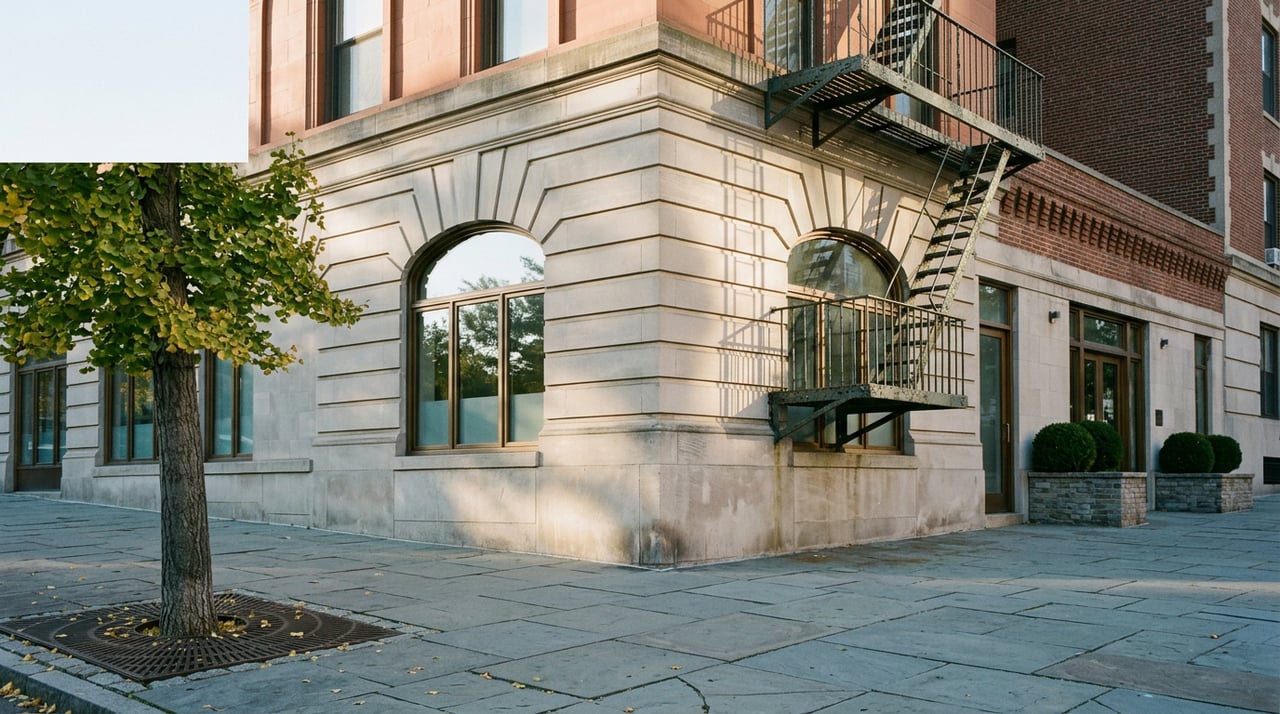
Walk up Fifth Avenue toward 23rd Street this month and the building looks finished. The scaffolding that has wrapped it since before the pandemic is gone, and for the first time in nearly a decade you can see the limestone base and the glazed terracotta upper floors the way Daniel Burnham drew them in 1902. It's easy to assume that means the doors are open too. They aren't. The ground floor sits behind glass and plywood, and the restaurant everyone in the neighborhood has been talking about since spring won't seat a single table until 2027.
That gap between what the building looks like and what it can actually do for you right now is the real story in Flatiron this September. The reveal is real. The programming that fills it is not here yet. And the neighborhood's actual food and event calendar this month is happening in the buildings around the Flatiron Building, not inside it.
The Wrap Comes Off, Nothing Moves In Yet
The scaffolding removal became visible in April, and the Landmarks Preservation Commission marked the moment with its own statement of relief at getting the "classic NYC view" back. The building is mid-conversion from office tower to 36 residential condominiums, a project led by the Brodsky Organization and Sorgente Group with Studio Sofield handling interiors. As of August 2026, 14 of those 36 units had sold, which puts the building a little under 40 percent through its sellout with 22 units, just over three in five, still on the market. That is useful context for anyone tracking how quickly a trophy conversion actually moves once the wrapping comes off: visibility and velocity are two different things.
The other headline from this year's work is permanent. In August 2025 the LPC approved a nighttime illumination scheme for the building's facade, the first time in its history it will be lit after dark on an ongoing basis. That detail matters more to residents than to anyone photographing the building once on a weekend trip. It changes what the block looks like every night, not just on the day you happen to walk by.
Then there's Bar Pisellino. Rita Sodi and Jody Williams, the chefs behind Via Carota, I Sodi, Buvette and The Commerce Inn, confirmed earlier this year that they'll bring a location of their all-day Italian cafe to the building's base, their first restaurant outside the West Village. Construction on the space began this summer, according to a Flatiron Building representative, but the opening date is 2027. So the building you're looking at today, the one that finally looks the way it's supposed to, still has at least a full year before anyone can order an espresso inside it.
Where The Actual Eating Is Happening This Month
While the building's own ground floor waits, the restaurants around it have not. Felice opened its new flagship this year inside the historic 220 Fifth Avenue building, directly overlooking Madison Square Park. It's the Tuscan-inspired brand's largest New York opening since it started on the Upper East Side in 2007, and the design leans into the address rather than shrinking from it: windows wrap three sides of the dining room, and the ceilings are tall enough that the space reads more like a public room than a neighborhood trattoria. If you want proximity to the Flatiron Building's view without waiting for its restaurant, this is currently the closest you can get.
A few blocks over, El Califa De León opened a five-taco counter, no frills, just gaonera, costilla, bistec, chuleta and a vegetarian option alongside margaritas. It's a different kind of opening than Felice, small-format and fast, but it says something about the neighborhood's current appetite that both a formal 220 Fifth Avenue flagship and a stripped-down taco counter can land in the same stretch of blocks within months of each other and both find an audience.
And on top of Eataly, Amalfi Rooftop by Birreria keeps doing what it has done every season for years: reinvent the 14th floor of 200 Fifth Avenue around whatever time of year it is, this time with coastal Italian dishes and views that include the Flatiron Building itself. It's worth noting that Amalfi is currently the one dining room in the immediate area that already looks toward the landmark the way Bar Pisellino eventually will. Until 2027, it's the seat you'd take if that view is the point.
What's Actually On The Calendar This Month
The Madison Square Park Conservancy publishes its own calendar, and the early fall lineup gives residents a reason to check it more than once this month rather than assuming nothing changes until the holiday lights go up.
| Date | Event |
|---|---|
| Sept 3 | In the Heights movie night on the lawn |
| Sept 8 | Garden Walk, focused on fall natives like asters and goldenrod |
| Sept 10 to 13 | IBM's US Open viewing, returning for a second year |
| Sept 16 | Evening art tour of Roberto Lugo's Alfarero del Barrio (Village Potter) |
| Sept 19 | Roberto Lugo's Tea Ceremony, an immersive performance tied to the same installation |
| Sept 22 | "The Gilded Age, Before, and Beyond," a history walk led by the Conservancy's executive director |
| Oct 3 | City of Forest Day, marking the park's status as Manhattan's only accredited arboretum |
None of this requires a reservation you'll lose to someone faster on their phone. Most of it is free. The US Open viewing is the one item on this list that draws a crowd big enough to change how the park feels for four days, so if you're planning to cut through around lunch that week, expect it.
James Mettham, president of the Flatiron NoMad Partnership, put the building's return in context for the district as a whole, calling it a symbol of renewal that reflects the neighborhood's broader evolution. That's a fair read of the last few years here. New public plazas, a growing list of restaurants, and year-round programming in the park have been building around the Flatiron Building's silhouette even while the building itself stayed under wraps. The landmark is catching up to the neighborhood, not the other way around.
What This Means If You Live Here
If you've been waiting for the Flatiron Building to signal that the neighborhood has "arrived," that signal already happened, just not through the front door of the building itself. It happened through Felice's decision to put its biggest New York investment in years across the street from it, through a taco counter that didn't need a landmark address to find customers, and through a park calendar that keeps finding new reasons to draw people outside through October.
The building's own contribution to that story is still ahead of it. When Bar Pisellino opens in 2027, it will be a genuine event, the kind that turns a corner into a destination on its own. Until then, the view from the building's base is better than the seating inside it. Treat this September as the season to enjoy what's already open around the landmark rather than waiting on the landmark to open itself.
If you're weighing what this kind of neighborhood momentum means for a home you already own or one you're considering here, Shelley Kaminer has spent her career reading exactly this kind of shift in Manhattan's core neighborhoods. Let's Connect.