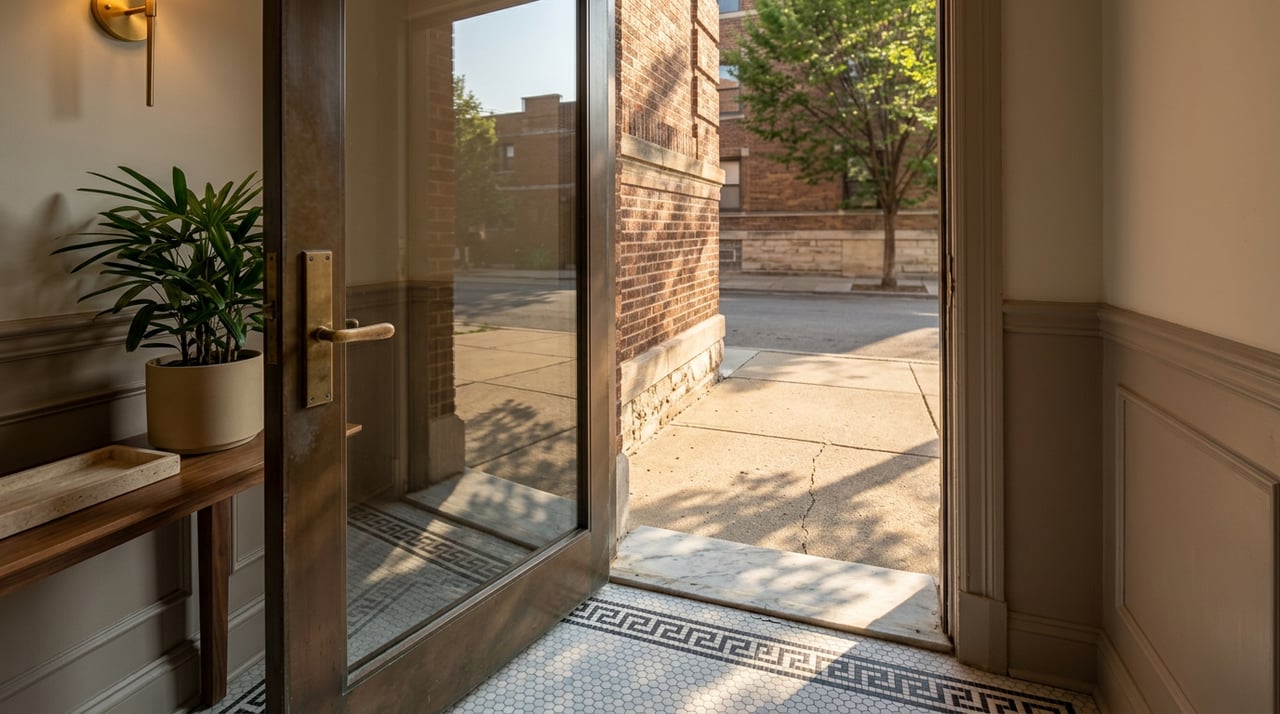
A new East Village café was announced on July 15 with a minimalist interior, coffee, ceremonial-grade matcha from Kagoshima, and a short list of specialty drinks. Archives Of Us, planned for 84 Second Avenue, is less interesting as another café than as evidence of a broader shift.
Across the neighborhood this summer, businesses are becoming more edited. Dining rooms have fewer seats. Menus are shorter. Shops are organized around one category. Service is increasingly walk-in, counter-based, and direct. Even Avenue B is being redesigned to carry less through traffic and give more space to pedestrians.
This is not a story about diminished ambition. It is a story about compression as strategy.
The East Village is reducing scale in order to sharpen identity.
That logic appears in four distinct ways:
- Smaller rooms make interaction part of the product.
- Narrower menus make a business easier to understand.
- Specialist shops turn curation into their primary value.
- A calmer street gives local activity more room to register.
The pattern is not universal, and the economics beneath it are not always elegant. Still, it is defining the texture of East Village summer 2026.
The new dining room asks for less commitment
Prosciutto opened June 15 at 435 East Ninth Street as a 20-seat, walk-in-only Italian restaurant. The name establishes a clear point of view before anyone enters. The room is compact, reservations are unnecessary, and the concept can be understood at street level.
Odo East Village takes the idea further. The 24-seat restaurant at 536 East Fifth Street has 13 counter seats and 11 table seats. Shinichiro Ogata designed the interior with copper accents, sand-textured walls, visible charcoal grills, and a dedicated sake-warming area.
The more consequential decision is operational. Odo translates formal kaiseki into a shorter, à-la-carte format. At its February 2026 opening, most regular menu items were priced at $20 or less. Diners can select what they want rather than commit to a long progression. Chefs cook, pour sake, and interact directly with guests.
Here, smallness is doing several jobs at once. It reduces the time commitment, brings the kitchen closer to the room, and makes service feel specific to the setting. Design and operating model are aligned.
That alignment matters. A small room without a clear idea can feel compromised. A small room with a disciplined idea can feel complete.
Fewer choices are becoming a form of clarity
The same principle is visible along First Avenue.
Tacos Domingo opened June 7 at First Avenue and St. Mark’s Place with a few menu items, charcoal-grilled meats, handmade flour tortillas, and standing communal tables. The business does not need an extensive menu to explain itself. Its concentration is the message.
Sanwits, at 149 First Avenue, opened in May with six Filipino sandwiches. The shop comes from the team behind nearby Naks, but it translates that culinary perspective into a format that is direct and legible. A person passing the storefront can understand the proposition quickly without flattening the food into something generic.
Nori Shinn opened April 29 at 210 First Avenue as a counter-seating, walk-in-only hand-roll restaurant. At opening, individual hand rolls were priced from $6 to $10, with sets from $25 to $36 and service included. The format removes several layers of ceremony while retaining a focused product.
Paulie Gee’s East Village Slice Shop makes a similar case through design. The shop at 100 First Avenue has four tables, a window counter, and a straightforward pizza focus. Checkerboard tile, wood paneling, a mural, and a 1970s rec-room sensibility give the compact interior a recognizable identity.
These businesses are not competing through maximum choice. They are competing through definition. That distinction is increasingly valuable in a neighborhood where attention is limited and every storefront must communicate quickly.
Specialization has moved beyond the restaurant
Wild Sorrel Cookbooks opened this spring at 332 East 13th Street with one category: cookbooks.
That sounds narrow until the selection is considered. Owner Troy Chatterton, who previously spent 14 years at Three Lives & Company, has built the shop around books for home cooks across a wide range of cuisines, cultures, and traditions. He lives nearby and selected the East Village partly because he can walk to work.
The shop’s value comes from selection rather than scale. A general bookseller can offer more categories. Wild Sorrel can make one category feel expansive through judgment, owner presence, and local context.
Fifth Square, which debuted in June at 304 East Fifth Street, uses a similarly concise pairing. The husband-and-wife-owned café centers on lattes and waffle pops, drawing inspiration from a visit to Dhaka. Once again, the concept is small enough to state in a sentence and distinct enough to remember.
Rabbit Books and Bar is planned for 170 Avenue A, though its opening had not been confirmed as of July 15. Mother-and-daughter owners Marianna Vaidman Stone and Emily Samara Stone have described a personal third space with international fiction, a small bar, book clubs, and community gatherings.
Its proposed rhythm is particularly well considered. Coffee, tea, matcha, and pastries would support mornings. Beer, wine, soju cocktails, and vermouth would carry the room into the evening. The format stays useful across the day without becoming an all-purpose operation with no clear center.
In each case, curation is not decorative language. It is the business model.
Avenue B makes the argument physical
The clearest expression of this summer’s shift is happening outside the storefronts.
On June 29, the New York City Department of Transportation began permanent upgrades to the Avenue B Open Street between East Fourth and East 12th Streets. Construction was expected to proceed over several weeks, weather permitting.
The design reduces through-vehicle volume and reverses traffic on part of the corridor. It adds loading zones, improves two-way cycling connections, and expands pedestrian space around Tompkins Square Park. Every intersection in the project area is slated to receive curb extensions protected by elements such as planters, bike corrals, or granite blocks.
Open Street hours remain 8 a.m. to 8 p.m. daily.
This is the title in literal form. The space devoted to through traffic becomes smaller. Crossing distances become shorter. Local access remains, while the corridor is positioned more clearly around walking, cycling, gathering, deliveries, and neighborhood businesses.
The design also reveals the broader mechanism at work. Compression is useful when the space recovered from one function is assigned thoughtfully to another. Less traffic capacity creates more pedestrian space. Fewer seats can create closer service. A shorter menu can give each item more significance.
Smallness alone is not the value. Reallocation is.
The economic pressure cannot be edited out
There is a polished interpretation of compact formats, but it is only part of the story. The neighborhood’s operating economics are also forcing difficult decisions.
Francis Kite Club, the hybrid bar, social club, and arts venue at 40 Avenue C, announced that it will close after service on August 1. Its founders cited a combination of rent, liability insurance, permits, and other rising costs.
Mee Noodle Shop nearly closed in July amid higher food and supply expenses, delivery-platform costs, lower business, and occupancy pressure. The longtime First Avenue restaurant remained open after its landlord agreed to reduce the monthly rent.
Two Boots left its longtime Avenue A corner after lease negotiations failed. In March 2026, the space had been marketed at $22,500 per month. Owner Phil Hartman said he was considering other East Village storefronts.
These examples complicate any easy celebration of the small-format trend. A tighter footprint may be an aesthetic choice, an operating discipline, or a survival strategy. Often, it is some combination of the three.
The distinction matters because the East Village is not becoming smaller through one coordinated vision. Individual operators are responding to cost, attention, space, and changing patterns of use. The strongest responses turn those constraints into a clear experience.
One large arrival keeps the thesis honest
Barnes & Noble provides the necessary counterpoint. The bookseller signed a lease for approximately 11,300 square feet at 181 Avenue A and is expected to open in November 2026.
The neighborhood is not uniformly moving toward tiny rooms and highly limited formats. Large retail can still enter when the location, tenant, and economics support it. Barnes & Noble will also meet a different need from Wild Sorrel or Rabbit Books and Bar.
The more precise observation is that many of this year’s most distinctive arrivals are succeeding conceptually before they succeed physically. Their identities are edited. Their rooms and menus follow.
The summer calendar follows the same logic
Tompkins Square Park has already hosted free local punk shows, a Show Brain concert, and a Jenkem skate block party with temporary obstacles this July. These are events a resident can enter casually, without converting the afternoon into a formal itinerary.
The summer’s anchor arrives later. The free Charlie Parker Jazz Festival returns for its 34th edition from August 28 through August 30. The Tompkins Square Park program is scheduled for August 30 at 3 p.m., with Ravi Coltrane, Kassa Overall, and Vanisha Gould.
That event carries a major cultural lineage, yet its setting remains immediate: a neighborhood park, an open afternoon, and no elaborate barrier to participation.
This is the East Village’s current position. Its value is not based on offering the most of everything. It comes from placing strong ideas in close proximity and allowing residents to encounter them without excessive planning.
A 20-seat Italian room. Six Filipino sandwiches. A bookstore devoted to cookbooks. A café built around matcha and coffee. A street calibrated for local movement rather than through traffic.
In East Village summer 2026, smaller is not an apology. It is a decision about what deserves the space.
If you are considering how an East Village apartment should be understood or positioned within this changing neighborhood context, I welcome a discreet conversation about timing, presentation, and value. Let’s Connect.